
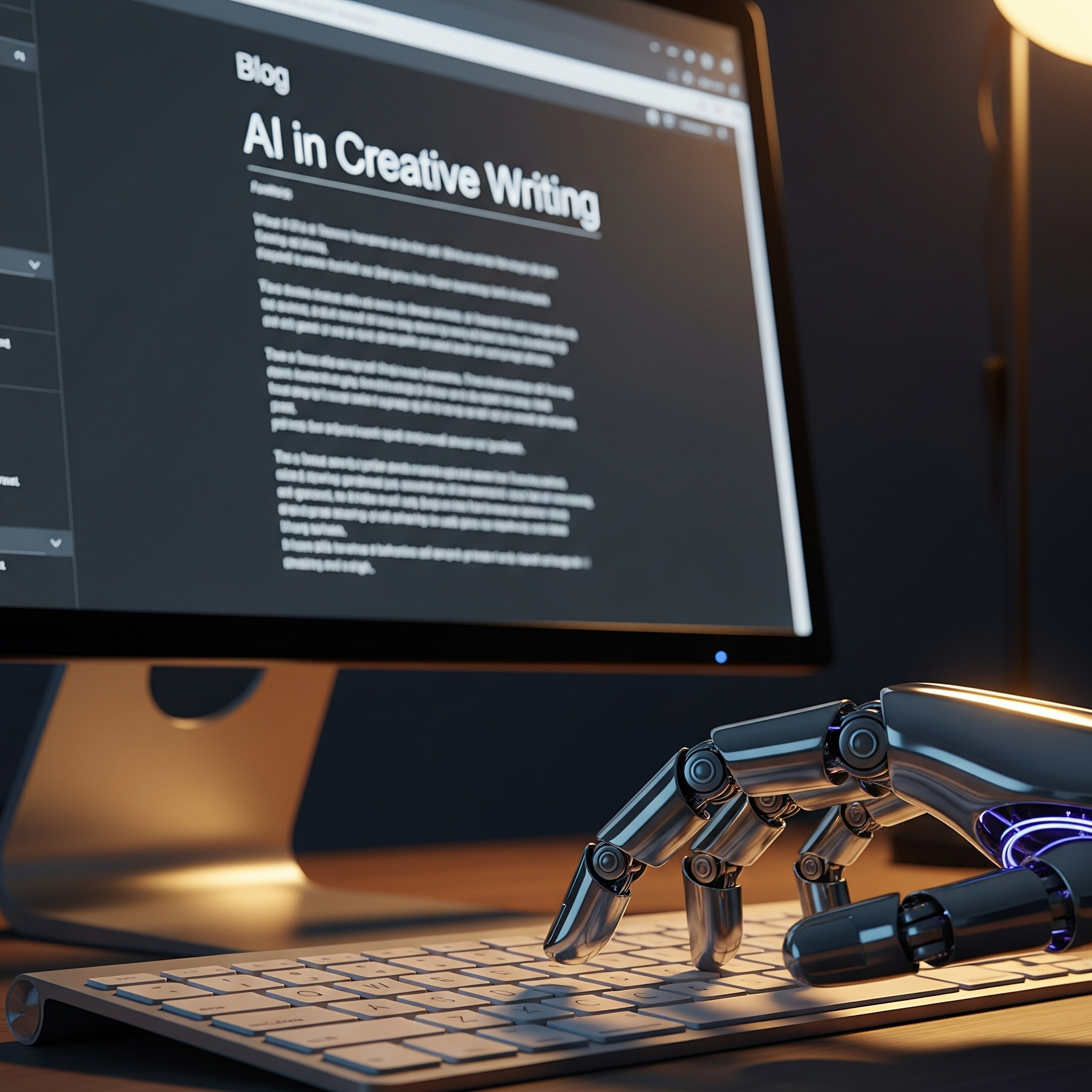
From Rudimentary Tools to Creative Partners
The history of AI in creative writing is a story of rapid evolution. It began with conceptual work like Alan Turing’s “imitation game” in the 1950s and early chatbots like ELIZA.1 Over time, these tools progressed from simple grammar and spell checkers in word processors to generating full-length books, such as
The Policeman’s Beard is Half Constructed.2 The most significant leap occurred with the development of neural networks and transformer models, which allowed AI to produce coherent and contextually appropriate text that mimics human style and structure.3
Today’s AI writing assistants are no longer just passive tools; they are active co-pilots. Trained on massive datasets of existing works, they can help with the entire creative process, from brainstorming and outlining to drafting and editing.5 These tools can generate everything from social media posts and email copy to complete blog articles, adapting their output for different platforms and formats.2 By automating the more formulaic aspects of writing, AI allows human creators to focus on the strategic, conceptual, and emotional elements that remain their unique strength.
The Modern Content Creator’s Toolkit: Choosing Your AI Partner
When selecting an AI tool, it’s essential to understand the difference between the underlying AI model and the specialized application. A large language model (LLM) like ChatGPT is the powerful “engine,” while a tool like Sudowrite is the “appliance” or “wrapper” that uses that engine for a specific task.7 The market offers a wide range of tools tailored to different needs, from general-purpose chatbots to highly specialized software for a particular use case.
The following table provides a high-level overview of some of the leading AI writing tools.
| AI Writing Tool | Primary Use Case | Key Features | Pricing Model |
| Claude Pro | General-purpose chatbot, creative prose | Exceptional quality of prose, large context window, Google Drive integration | $17/month (billed annually) |
| ChatGPT Plus | General-purpose chatbot, versatile tasks | Powerful LLMs, DALL-E integration, custom GPTs, Canvas | $20/month for Plus version |
| Gemini Advanced | General-purpose chatbot, research | Deep research features, integration with Google Workspace | $19.99/month for Pro |
| Sudowrite | Fiction writing | Muse model for natural prose, intuitive scene structure, free trial | Pricing structure varies, free trial available |
| Anyword | Marketing, SEO | Predictive Performance Score, brand personas, Brand Rules | Starts from $49/month |
| Copy AI | Copywriting | Marketing-focused templates, iterative output refinement, unlimited plans | Free plan available, starts from $36/month |
| Frase IO | SEO, content optimization | SEO-focused features, analyzes content vs. SERP competitors | Starts from $45/month |
The Strategic Imperative: The Human-AI Partnership
AI-assisted writing is an incredibly powerful way to boost productivity and creativity. These tools are fast and cost-effective, capable of producing a content draft in minutes that would take a human hours.5 They can also serve as a great brainstorming partner, helping to overcome writer’s block by quickly generating ideas and outlines.5
However, AI has significant limitations that make human expertise indispensable. AI models lack “real-world experience” and are incapable of original, creative thought.5 An AI cannot conduct original research or provide a unique, firsthand perspective that builds trust and authority with an audience.5 This is directly relevant to search engine optimization (SEO). Google’s E-E-A-T framework (Experience, Expertise, Authoritativeness, and Trustworthiness) is designed to reward content that an AI cannot produce on its own.10 When AI can generate a passable article in seconds, human authenticity becomes the most powerful and defensible ranking signal available.11
Other key limitations include the risk of “hallucinations,” where the model generates plausible but factually incorrect information 6, and the inability to consistently replicate a brand’s unique voice.5 AI also inherits the biases present in its training data, placing the responsibility of fact-checking and bias elimination on the human author.6
Ranking Your AI-Assisted Content
To succeed in a world of AI-generated content, SEO strategy must focus on building a personal or brand authority around an “entity”.10 This means that the credibility of the “who” behind the content is now more important than the “what”.10 A human author can build a reputation through consistent bylines, detailed bios, and earning high-quality backlinks, all of which signal to search engines that they are a trusted source.10
AI excels at handling the “grunt work” of SEO. It can be used for:
- Long-tail keyword research: AI can process millions of queries to uncover specific, less competitive search phrases with high conversion potential.14
- On-page optimization: Tools can generate detailed outlines and suggest headings to improve structure and readability, and they can craft compelling meta titles and descriptions to enhance search visibility.16
The Visual Advantage: Integrating Images
Integrating unique, custom visuals is crucial for a blog post’s success. Visuals increase engagement, break up long text, and are processed by the human brain much faster than words.18 AI image generators like SEOWriting and GravityWrite have made it easy to create unique graphics that perfectly match your content, simply by describing what you need.18 For a blog to rank, these images must also be optimized for search engines with descriptive alt text for accessibility and indexing.18
Ethical & Legal Considerations
Using AI in creative writing comes with important ethical and legal considerations. The core issue is that AI systems are trained on vast, often copyrighted, datasets of human work without compensation.9 As a result, the output is not considered an “original” creation and may not be protected by copyright.9 For this reason, The Authors Guild advises that authors must disclose any significant use of AI-generated text to their publishers and readers, as many will feel deceived otherwise.9 Transparency builds trust, which is the most valuable asset in the new SEO and content landscape.
The Final Blueprint: A Step-by-Step Plan
Successfully integrating AI into your workflow is not about replacing the human but leveraging the technology’s strengths to amplify your own.
- Strategy & Ideation: Start with a human-led strategy. Use AI to brainstorm, find long-tail keywords, and create an initial outline.5
- Drafting with a Human Touch: The human writer then drafts the content, injecting unique experiences, personal stories, and original research that an AI cannot.5
- Refinement & Optimization: Use AI tools like Grammarly to polish the draft, check for errors, and ensure natural keyword integration without “keyword stuffing”.20
- Visuals & Authority Building: Create unique AI-generated images with proper alt text and publish the article with a consistent byline.10 Actively promote your work to build your reputation and earn backlinks, which future-proofs your content.11
The future of creative writing is a collaboration. By leveraging AI to handle the mundane tasks, the human writer is freed to focus on what truly matters: originality, authority, and building a trusted reputation.